

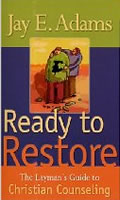
Ready to Restore: A Layman's Guide to Christian Counseling
by Jay E. AdamsProduct Overview
You don’t have to be a professional counselor to help people solve
problems. But you do have to understand the principles and practices of
biblical counseling.
Here is a guide to Christian counseling written specifically for
laypeople. Jay E. Adams, a pioneer in the field of counseling, has taken
the most essential elements of counseling and packaged them in this
thorough but non-technical volume. The result is neither simplistic nor
superficial, but a complete, systematic course, useful for study groups,
Bible colleges, church leaders, and individual study.
Comments about this book
- Comment here...
About the Author

Jay E. Adams
Jay E. Adams is best known for his many books, including Competent to Counsel, The Christian Counselor’s Manual, Christian Living in the Home, and Solving Marriage Problems. He served for many years on the faculties of Westminster Theological Seminary (Philadelphia) and Westminster Theological Seminary in California, and founded the Christian Counseling and Educational Foundation in Glenside, Pennsylvania. Retired from the pastorate, Dr. Adams continues to write and speak on counseling and Christian living issues.
List Price: $11.99
Our Price: $8.00
You Save: $3.99 (33%)

Paperback: 111 pages
Publisher: P&R Publishing (April 1999)
Language: English
ISBN-10: 0875520707
ISBN-13: 978-0875520704
Dimensions: 8.5 x 5.6 x 0.4 inches
Weight: 7.4 ounces

Loving Truth Books & Gifts Review
This book, as the subtitle indicates is The Layman's Guide to Christian
Counseling, and, while brief, it is jam-packed with valuable information. I
am not a "trained" counselor but often find myself in situations where I am
called upon to "counsel"/ advise others.
This book is laid out in 16 brief chapters, the final chapter containing a
somewhat dated list of resources to help one grow as a counselor. Do not let
that stop you, however, from heeding Dr. Adam's poignant admonition in the
opening of chapter 16 that to be truly competent to counsel others one must
first grow as a Christian and second grow as a biblical student and
practitioner.
Much of the material presented gives one a great overview and framework for
counsel. Dr. Adams writes in a clear thorough manner. I found Chapter 9 to
be particularly helpful in his discussion and suggestive list for extensive
questioning with sample forms for providing structure. Also, time and again,
Dr. Adams stresses that Biblical counseling is NOT psychology and he wants
the lay counselor to be clear about this as well as to be using Biblical
language rather than "pop-psychology."
Another nugget of great information that one might miss if reading quickly
is found on page 64 where Dr. Adams points out the differences between
Transcendental Mediation (T.M.) versus Biblical meditation, where he states
"Christian meditation is not a trance; it is thought--deep thought--about
truth, it's implications, and its implementation." Meditation, therefore, is
a process of thought rather than feeling.
Review By: Angela Zaev
Related Products
We accept all major credit cards via secure PayPal checkout (registration is optional)
|
 Zaev Holdings LLC,
owner of the "Loving Truth Books & Gifts" store, is a
PayPal Verified Merchant. Zaev Holdings LLC,
owner of the "Loving Truth Books & Gifts" store, is a
PayPal Verified Merchant.
|
 Find high quality 18/10 Stainless Steel kitchenware products, plus free recipes at
Old World Cuisine, also owned and operated by Zaev Holdings LLC. Find high quality 18/10 Stainless Steel kitchenware products, plus free recipes at
Old World Cuisine, also owned and operated by Zaev Holdings LLC.
|

If you would like
to link to us, please use some of the banners and available code on the
Link to Us page.


